AI agent
An AI sales agent on WhatsApp: what it should do, and what it shouldn't
What a good AI sales agent on WhatsApp looks like: it answers from your real catalog, asks one good question, sends a payment link and knows when to hand off. Plus how to stop it making things up.
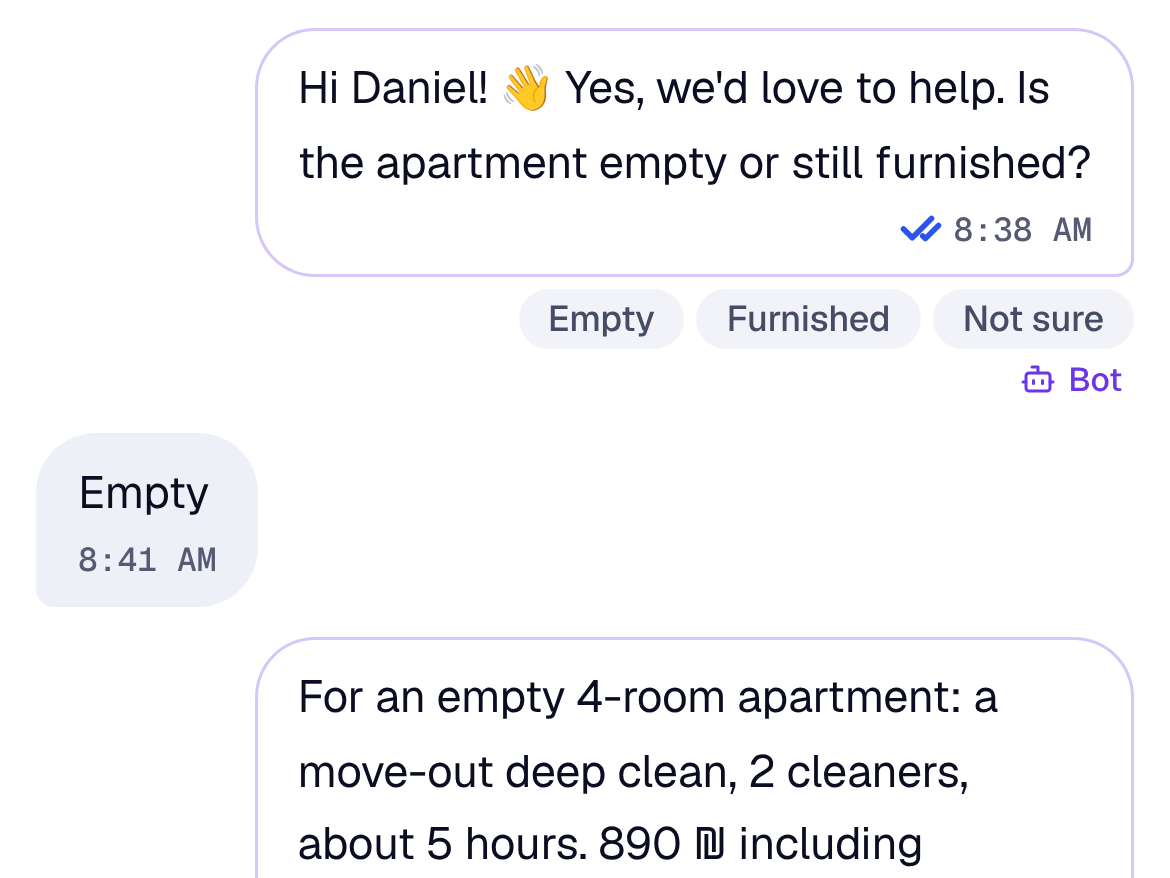
An AI agent on WhatsApp can answer customers at any hour, in any language, without getting tired. It can also invent a price, promise a delivery date that doesn’t exist or reply in a tone that doesn’t sound like you. Which one you get depends mostly on how you set it up. Here’s what a good sales agent does, where it stops, and how to check that it’s working.
It answers from your real catalog
The agent needs to know what you sell, what it costs and what’s in stock. Not general information from the internet, but your product pages, your price list and your delivery and returns policy.
When a customer asks about an e-bike for commuting, the agent should know your models, tell them apart and know which suits what. When someone asks about a post-renovation clean, it should know what’s included and what isn’t.
Worth checking:
- The agent reads the product pages on your site and picks up changes when they happen.
- Prices and stock come from one up-to-date source.
- Your policies (delivery, returns, cancellations) are written down somewhere the agent reads.
It asks one good question
A customer who writes “do you have sofas?” doesn’t want a list of twenty models. They don’t want a five-question survey either. A good agent asks one question that narrows things down: “Which room is it for, and roughly how much space do you have?”
Then it recommends two or three options, with a short reason for each. That’s what a good salesperson does in a store, and it’s what the agent should do in a chat.
It recommends and moves toward a sale
A good sales conversation reaches a point where the customer can buy. On WhatsApp that can look like this:
- The customer asks a question.
- The agent asks one question and works out what they need.
- The agent sends a product card with a photo, name and price.
- The customer says yes, and the agent sends a secure payment link.
- The customer pays on your own website’s checkout. Card details never go through the chat.
If the customer isn’t ready, the agent can offer a reminder, or log the conversation as an open deal so someone on the team follows up.
It knows when to hand off to a person
Some conversations shouldn’t be handled by an agent alone. Decide in advance when it hands off:
- Complaints and angry customers.
- Returns, exchanges and warranty claims.
- Financing or special payment terms.
- A failed order or a payment that didn’t go through.
- Any question whose answer isn’t in your content.
The customer shouldn’t feel the handoff. The agent tells the customer that someone from the team will continue, and leaves an internal note: what the customer wants, what’s been said and what’s missing. Your team doesn’t start from zero, and the customer doesn’t have to explain everything again. Once a person joins the conversation, the agent steps out and stays out.
A tone that fits your business
A beauty studio talks differently from a furniture store, and an online clothing shop talks differently from a cleaning company. Tell the agent how you speak: casual or formal, short or detailed, emoji or no emoji.
A few rules that almost always work:
- Keep messages short. WhatsApp isn’t email.
- Reply in the language the customer wrote in.
- Don’t flood. One question at a time.
- When a customer sends several messages in a row, wait until they’re done and reply once.
- Don’t reply within a second if that feels off for your business. A short delay on the first reply can feel more natural.
How to keep it from making things up
This is the most common worry, and a fair one. A few ways to keep it in check:
- Answer only from your content. If the information isn’t there, the agent says it will check and hands off.
- A “don’t offer” list. Products that are sold out, services you’ve stopped or promotions that have ended.
- No promises that aren’t written down: discounts, delivery dates, custom work.
- Read real conversations. In the first weeks, review some conversations every day and fix the content wherever the agent got it wrong.
How to tell if it’s working
Don’t go on gut feeling. Look at:
- How many conversations the agent resolved on its own, and how many it handed off.
- How many conversations turned into a sale or a paid payment link.
- How many payment links were sent and never paid.
- First-response time, especially evenings and weekends.
- What each agent conversation costs you.
The short version
A good AI agent behaves like a good salesperson: it knows the products, asks the right question and knows when to call the manager. In Chatles, the agent is built on Anthropic’s Claude, answers only from your business’s content, and hands off to your team with an internal note when a person is needed.